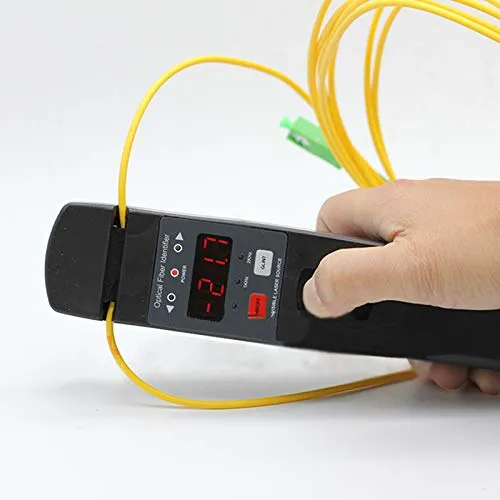
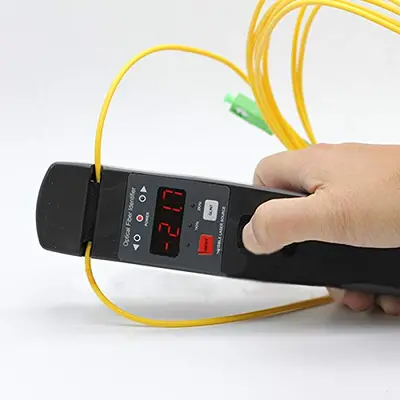
JW3306D Live Fiber Identifier This page
- Size
- 100 × 100 × 50 in
- Weight
- 0.440924524 lb
by D YEDEMC
Independent guide. Not the official D YEDEMC site.
The JW3306D is a handheld live fiber identifier covering 800-1700nm with a built-in VFL, made for checking signal direction on a fiber without cutting it.
Today's price and delivery date are shown on Amazon.
Check price on Amazon Read customer reviews on AmazonAs an Amazon Associate I earn from qualifying purchases.
It bends the fiber slightly so a little light leaks out, then reads that light. The maker says this does not damage the fiber or interrupt communications.
It shows which way the traffic is traveling and the relative core power. This helps avoid unplugging the wrong line.
It recognizes 270Hz, 1KHz and 2KHz tones, so you can find a specific fiber among many and get an audible warning.
A visible red laser with an FC/SC/ST universal interface is in the same tool. The maker says it reaches about 10-15 kilometers.
The detector covers 800-1700nm, and the display is an LED segment type that shows the reading.
When battery power runs short, the unit signals you to change the batteries, so a weak cell does not skew a reading.
| Wavelength range | 800-1700 nm |
|---|---|
| Insertion loss | 1.0dB |
| Signal tones | 270Hz / 1KHz / 2KHz |
| Detector | 1mm InGaAs |
| Min. detection power | -35dBm (1550nm), -30dBm (1310nm) |
| VFL center wavelength | 650nm |
| Operating temperature | 0 to +50℃ |
| Weight and size | 200g, 230*43*48mm |
Yes, it indicates signal presence or absence, so you can separate live fiber from dark fiber, and it also shows traffic direction.
Does it give accurate power readings?No, it shows relative core power only. The maker says to use a power meter when you need an accurate power measurement.
Will it work at 850/1300nm?It can detect from 800-1700nm, but the maker says 850/1300nm is hard to measure because less light leaks out. The easiest wavelengths are 1310/1550nm.
Are batteries included?No, the package has the identifier and a user manual, and batteries are not included.
What fiber sizes does it take?The maker lists 250um, 900um, 2.5um and 3mm fiber, including tight jumpers.
How is it different from the YD-3309D Identifier with OPM?The JW3306D is an identifier with a built-in VFL and relative power display only. The YD-3309D adds a power meter function, as its name says, so pick it if you want both in one tool.
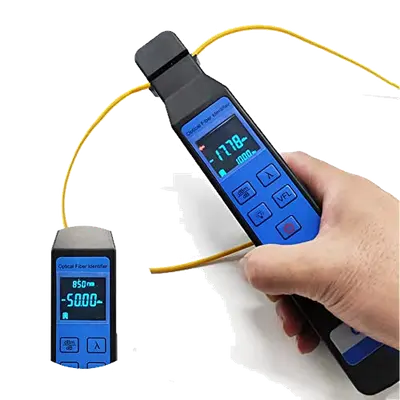
| JW3306D Live Fiber Identifier | YD-3309D Identifier with OPM | |
| Size | 100 × 100 × 50 in | 9.06 × 1.42 × 1.96 in |
|---|---|---|
| Weight | 0.440924524 lb | 0.440924524 lb |
| Check price on Amazon | Check price on AmazonDetails |